What is a 4-stroke engine?
A 4-stroke engine is an Internal combustion engine, where four
successive strokes (i.e. Suction-Compression-Power-Exhaust)
completes in two revolutions of the crankshaft. In recent days the
majority of automobile runs on a four-stroke cycle.
Let us first understand some basic terms associated with a
4-stroke engine.
- Top dead center (TDC): It is the extreme
position of the piston at the head end of the cylinder. At TDC
the crank angle is 0°
- Bottom dead center (BDC): The extreme
position of the piston at the crank end side. At BDC, the crank
angle is a 180°
- Cylinder bore: It is the internal diameter
of the cylinder.
- Stroke: It is the distance through which
the piston moves in the cylinder during 1 stroke.
Classification of 4-stroke engine
The four-stroke engine is generally classified into 2 types:
- Four-stroke petrol engine
- Four-stroke diesel engine
Let us understand each one in detail.
Four-stroke Petrol engine
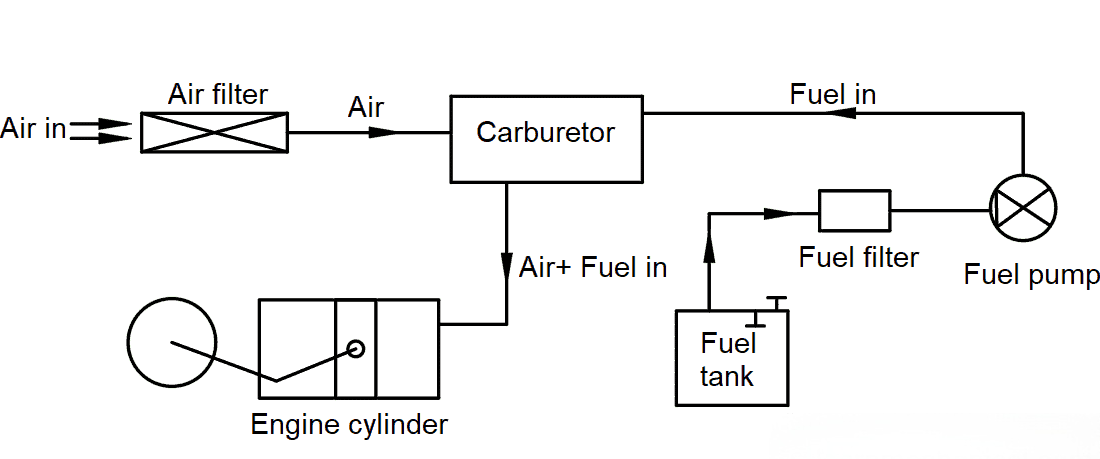
This type of engine is based on the Otto cycle. Let us have a
look at individual parts of a 4-stroke petrol engine.
Construction of Four-stroke Petrol engine
A four-stroke petrol engine consists of the following:
- A cylinder
- Cylinder head attached with spark plug
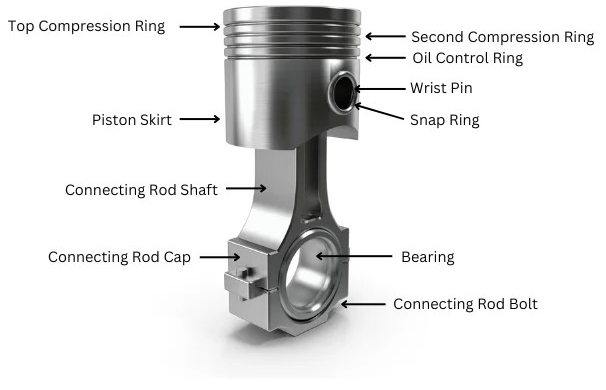
- Piston attached with piston ring
- Connecting rod
- Crank
- Crankshaft
- Valves
In four-stroke engines, Valves are used instead of Ports.
Following are the two valves used:
- Suction valve
- Exhaust valve
And these valves are operated by means of Camshaft. It is rotated
at half the speed of a crankshaft.
Working principle of the Four-stroke petrol engine
The travel of the piston from one dead center to another is
called piston stroke and a four-stroke cycle consists of four
strokes which are as follows :
- Suction Stroke
- Compression Stroke
- Power or Expansion Stroke
- Exhaust Stroke
Suction stroke
In this stroke the suction valve opens while the exhaust valves
remain in close condition. The piston moves from the top dead center
to the bottom dead center and the charge (Air+Fuel) enters the
engine cylinder due to the partial vacuum developed inside the
cylinder. When the piston reaches the BDC, the inlet valve closes
and the flywheel makes a half revolution.
Compression Stroke
In this stroke, Piston moves from BDC to TDC. The air inside the
cylinder is compressed and heated. In this stroke both the valves
are in closed condition. The mixture, which was sucked into the
cylinder during the suction stroke, is compressed into the
combustion chamber. The heat produced during the compression stroke
vaporizes the mixture. As the piston approaches the top dead center,
the compression stroke completes, and then the spark plug gives the
spark.
Power Stroke or Expansion stroke
Again both the inlet and exhaust valves are closed in this stroke.
The compressed charge is ignited by the high intensity of the spark
and expands adiabatically. Therefore, it pushes the piston downward
i.e. towards BDC to complete the stroke.
Exhaust Stroke
During the exhaust stroke, the inlet valve is in a closed condition
and the exhaust valve is opened. The piston rises up from BDC to
TDC. The stroke is completed when the piston reaches the Top Dead
Center. In the exhaust stroke in one situation both the valves are
in an open condition for some seconds so that fresh charge enters
the engine cylinder and pushes the burnt gases out of the cylinder.
This process is called Scavenging.
Valve-timing diagram for four-stroke Petrol engine
Theoretical valve-timing:
- The Inlet valve opens when the piston is at TDC
- The Inlet valve closes when the piston reaches BDC
- Spark produces when the piston reaches TDC
- The exhaust valve opens when the piston is at BDC
- Exhaust valve close when the piston is at TDC
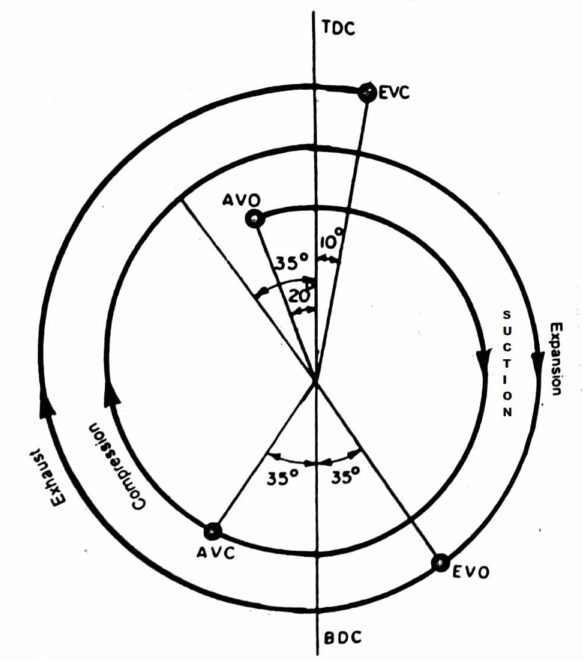
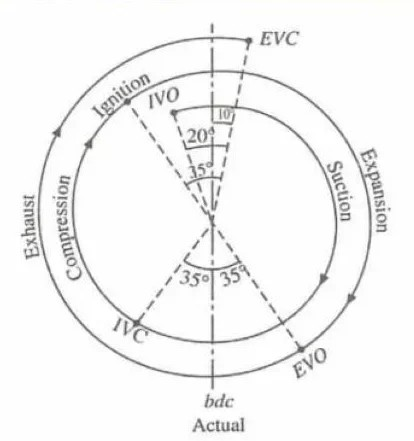
Actual valve-timing:
- The Inlet valve opens about 10°-20° before TDC
- Inlet valve close 30°-40° after BDC to take advantage of
rapidly moving gas
- The spark occurs 20°-35° before TDC
- The exhaust valve opens about 30°-50° before BDC
- Exhaust valve close about 10°-15° after TDC
Applications of Four-stroke Petrol engine:
- Automobiles
- Motorcycles
- Cars
- Buses
- Trucks
- Airplanes
- Small pumping sets
- Mobile electric generator
Four-stroke Diesel engine:
Construction:
- A fuel injector
- Fuel pump
- Cylinder
- Cylinder head
- Inlet and exhaust valves
- Piston
- Piston ring
- Connecting rod
- Camshaft
- Crankshaft
- Cam
Working principle of Four-stroke Diesel engine:
The cycles of the Four-stroke diesel engine are the same as that
of Petrol engine.
- Suction Stroke
- Compression Stroke
- Power or Expansion Stroke
- Exhaust Stroke
Suction Stroke:
In a suction stroke, the inlet valve is in the opened condition and
the exhaust valve remains closed. The atmospheric air is drawn into
the cylinder as the piston moves from TDC to the BDC due to the
partial vacuum air sucked inside the cylinder.
Compression Stroke:
In this stroke, Piston moves from BDC to TDC. As a result, the air
inside the cylinder is compressed and heated. In this stroke both
the valves are in closed condition. The temperature of air is around
800°C. At the end of the compression stroke, the fuel injector
injects the fuel at high pressure to the compressed hot air, thus
the ignition takes place inside the cylinder.
Power or Expansion Stroke:
During this stroke, both the valves are in closed condition. The
piston at the TDC is pushed downward by the expansion of burned gas.
Therefore a Power stroke is produced.
Exhaust stroke:
In this stroke, the exhaust valve is opened and the inlet valve is
in the closed condition. The piston travels from BDC to TDC and
pushes the burned gas out of the cylinder. And here also the
scavenging process is used to remove the burnt gas completely.
Valve-timing diagram for four-stroke Diesel engine:
Actual valve-timing diagram:
- Inlet valve open at 10°-30° before TDC
- The Inlet valve closes at 20°-50° after BDC
- The exhaust valve opens approximately 40° before BDC
- Exhaust valve close 15° after TDC
- Fuel injection starts 5°-15° before TDC
- Fuel injection stops 15°-25° after TDC
Applications of Four-stroke Diesel engine:
- Small pumping sets
- In the automobile industry
- Air compressor
- Drilling jigs
- Boats and Ships
- Power saw
- Bulldozers
- Tanks
- Diesel-electric locomotives